
- Óptica automotriz
- Imagen & Visión
- Capacidades ópticas
- Productos & Aplicaciones
- Recurso
- Ópticas de vidrio personalizadas
- Moldes ópticos
- Recubrimiento OPático
- Moldeo óptico
- Herramientas ópticas
- Videos de Herramientas
- Prisma & Filtros
- Partes ópticas personalizadas
- Iluminación & Iluminación
- Medicina & Endoscopia
- Aplicaciones ópticas
- Electrónica de consumo
- Visión industrial
- Lentes Asféricas
- Lentes Esféricas
RFQs de doblete acromático: Definir conjugados y orientación
Indagación- Descripción
An achromatic-doublet RFQ should describe the optical task, not just a diameter and focal length. A lens intended to focus a collimated beam needs a different review from one used between two nearby image planes. Put those conditions beside the drawing so purchasing, optical engineering and the supplier are quoting the same requirement.
Define What the Doublet Must Correct
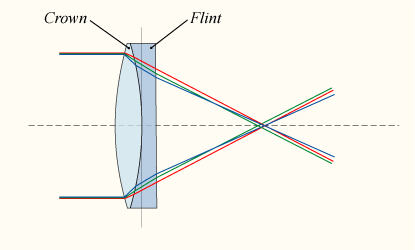
A conventional achromatic doublet combines two optical elements, commonly a positive crown-glass element and a negative flint-glass element. The additional design freedom supports chromatic correction compared with a singlet. Sin embargo, “achromatic” is not an acceptance specification for every wavelength, field position or aperture. Edmund Optics explains the construction and distinguishes several achromatic configurations in its achromatic-lens application note.
For procurement, list the operating wavelengths or spectral band and identify which performance measure matters to the instrument. Request a supplier response against that measure rather than a general assurance of good image quality. If a requirement has not been decided, mark it for engineering review instead of copying a tolerance from an unrelated catalog lens.
Put Conjugates and Orientation on One Sketch
Include the object location, intended image location, direction of light travel and working aperture. State whether the input is collimated. Label the lens surfaces consistently between the optical prescription, mechanical drawing and assembly instruction.
Orientation guidance is design-specific. Ask the proposed supplier to confirm which surface faces the incident light for the actual prescription and the stated object and image distances. Avoid assuming that the orientation of a catalogue lens applies to an alternative prescription.
For an existing instrument, attach the relevant assembly cross-section. For a new design, record who is responsible for approving the optical layout before the mechanical envelope is frozen. This prevents a quotation assumption from becoming an undocumented assembly instruction.
Separate Optical Targets From Mechanical Fit
- Optical definition: wavelength band, conjugates, apertura, focal-length designation and the agreed performance metric.
- Mechanical definition: outside diameter, thickness envelope, seating reference, available axial space and retention arrangement.
- Surface identification: entrance face, exit face and the permitted location of any orientation mark.
- Acceptance evidence: revisión de planos, método de inspección, sampling agreement and the conditions associated with each reported result.
Write the focal-length designation explicitly. If the assembly needs a distance from a physical lens surface or housing shoulder, name that reference and request the corresponding dimension. Do not leave an unlabeled “focal length” value to carry both the optical-design and mechanical-installation requirements.
Keep Coating and Cosmetic Inspection Separate
Add the required coating band and operating conditions as their own line items. A doublet drawing should not force the supplier to guess whether a coating note applies to the external surfaces, and a transmission target should state the test conditions and acceptance limit. La AR-coating RFQ checklist provides a separate framework for that discussion.
Igualmente, keep cosmetic inspection distinct from optical performance. Agree the inspection method and relevant surfaces rather than relying on a scratch-dig number without its context. See the surface-quality acceptance guide when preparing the inspection note.
Request a Compliance Reply Before Release
Ask the quotation to identify compliant requirements, proposed deviations and unresolved questions. Keep any alternative prescription, glass substitution or dimensional change visible for review. A useful RFQ closes with the drawing revision, cantidad, intended assembly conditions and requested inspection deliverables. Those details give both parties a clearer basis for deciding whether the proposed achromatic doublet fits the instrument.
Recurso, Blogs
ENVIAR CONSULTA
Productos relacionados
© Silveroptics 2026. Todos los derechos reservados
Funciona con Silveroptics
Servicio
