

- Lighting & Illumination
- Medical & Endoscopy
- Optical Applications
- Automotive Optics
- Imaging & Vision
- Optical Capabilities
- Products & Applications
- Resource
- Custom Glass Optics
- Optical Molds
- OPtical Coating
- Optical Molding
- Optical Tooling
- Tooling Videos
- Prism & Filters
- Custom Optical Parts
- Consumer Electronics
- Industrial Vision
- Aspheric Lenses
- Spherical Lenses
Glass Lens Applications: Match Inspection to the Optical Task
Inquiry- Description
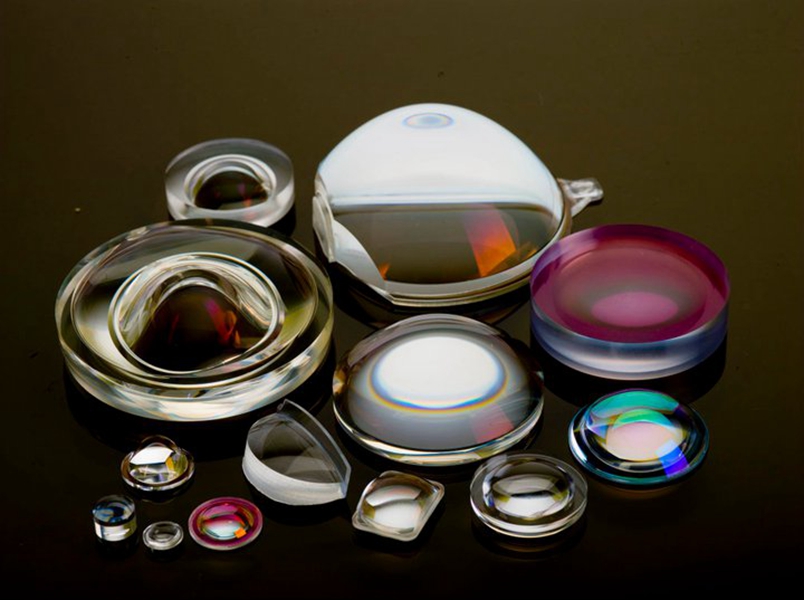
Image: Glass optical components in a range of shapes, sizes and surface finishes.
Should a glass lens for a camera be accepted using the same evidence as a lens for an optical measurement instrument or laser system? The component may look similar, but the errors that matter can be different. Inspection should follow the optical task and the conditions under which it must be performed.
Imaging: preserve useful detail across the field
Cameras and microscopes need to transfer detail from an object into an image. Focus, aberrations and alignment determine how much contrast survives at different levels of detail. A sharp image at the center does not establish performance across the full field.
Define the wavelengths, aperture and working distance, then assess relevant field positions. Modulation transfer function, or MTF, relates image contrast to spatial frequency and provides more useful evidence than an unsupported resolution claim. Compare measurements under consistent conditions, including focus. The glass lens introduction explains the underlying material and shape effects.
Measurement: control the light path
In optical instruments, lenses may collect, collimate or focus light onto a detector or measurement region. Surface-form errors, misalignment and unwanted reflections can change that light path or introduce background signals.
Choose evidence that addresses the measurement mechanism: transmitted-wavefront or collimation checks where appropriate, spectral transmission at the operating wavelengths, and functional tests in the intended geometry. For diagnostic instruments with cleaning or sterilization requirements, assess the optical assembly after the required process, including its coatings, adhesives and mounts.
Lasers: connect the lens to the exposure conditions
A laser lens must transmit and shape the beam while tolerating the intended exposure. Absorption, surface contamination and coating defects can contribute to damage. Suitability depends on the wavelength, beam size, operating mode and, for pulsed sources, pulse conditions.
Review relevant substrate and coating damage-threshold data. A general glass temperature rating cannot replace evidence related to the laser exposure.
Check performance after integration
For each application, connect component inspection to an assembled-system result. Temperature changes, mounting stress and alignment can alter performance after installation. The glass lens benefits and limits guide describes these interactions.
Record the test setup with the result. An image, wavefront map or transmission curve becomes useful acceptance evidence only when its conditions correspond to the intended optical task.
Consumer Electronics
SEND INQUIRY
Related Products
© Silveroptics 2026. All rights reserved
Powered by Silveroptics
Service
