

- Tooling Videos
- Prism & Filters
- Custom Optical Parts
- Lighting & Illumination
- Medical & Endoscopy
- Optical Applications
- Automotive Optics
- Imaging & Vision
- Optical Capabilities
- Products & Applications
- Resource
- Custom Glass Optics
- Optical Molds
- OPtical Coating
- Optical Molding
- Optical Tooling
- Consumer Electronics
- Industrial Vision
- Aspheric Lenses
- Spherical Lenses
Bandpass Filter RFQ: Define the Blocking Range
Inquiry- Description
A bandpass filter quotation can satisfy the requested center wavelength and still leave an important unwanted signal in the system. The acceptance document should distinguish the wavelengths that need to pass from the intervals that actually need rejection. A narrow requirement near an unwanted source line is different from broad detector protection. Give each interval its own endpoints and criterion instead of asking for “high blocking everywhere.”
Separate passband and stopband requirements
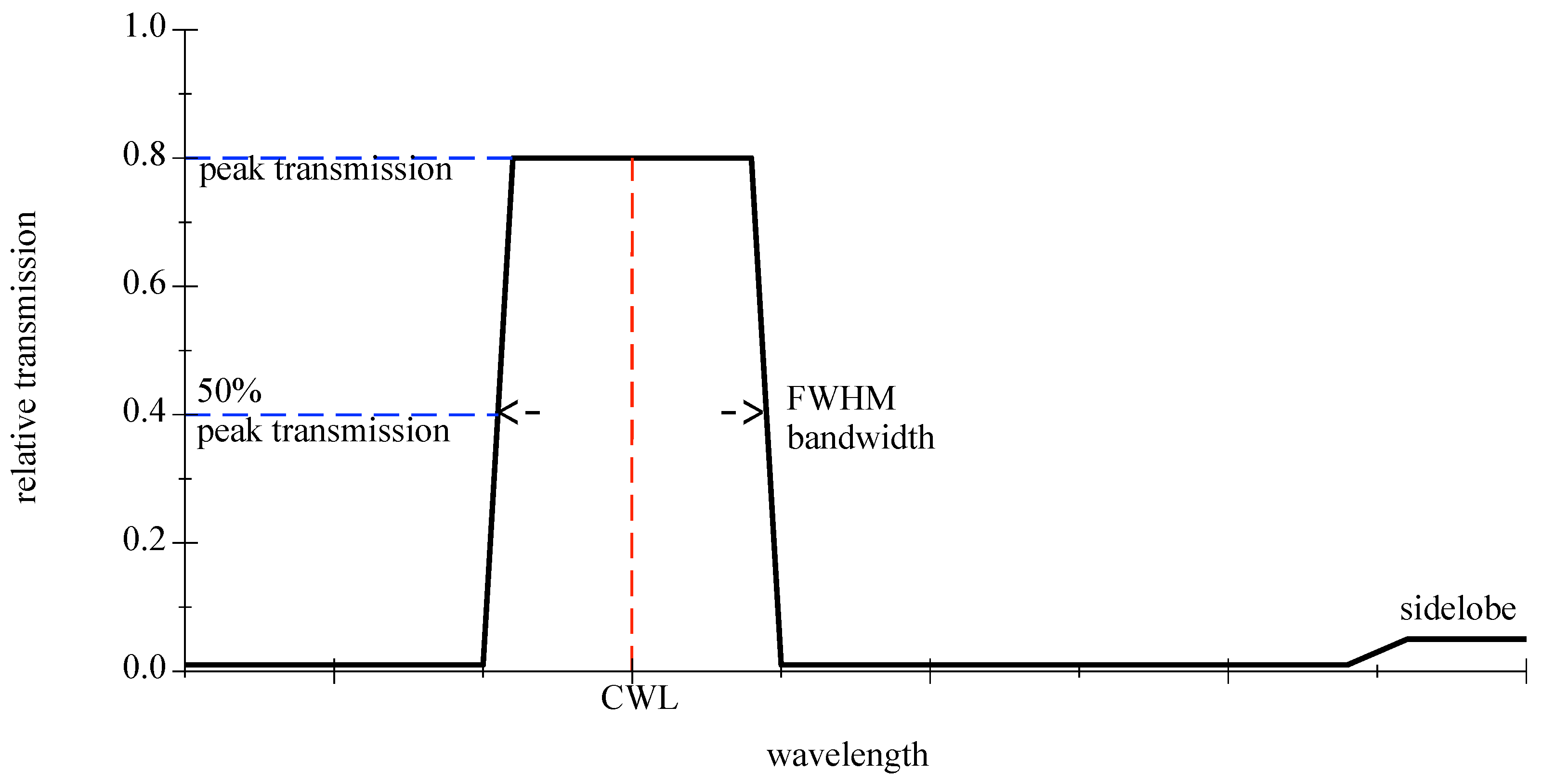
For the passband, identify the center wavelength, how bandwidth is defined, and whether the requirement is peak, minimum or average transmission. For blocking, list discrete wavelength intervals and state maximum transmission or minimum optical density. Indicate whether the limit applies at every wavelength, as a band average, or only at particular lines. Optical density is based on the ratio of transmitted to incident light; ensure everyone interprets the units consistently.
Make the test comparable
Specify the angle of incidence, incident cone if relevant, polarization and filter orientation. Request the scan wavelength step, usable instrument range and reporting floor for a deep-blocking requirement. If the setup cannot resolve the specified rejection, a curve that reaches the reporting floor is not evidence of a lower value. Ask which measurements are made on finished components and which, if any, come from witness coupons.
Close the quotation with an agreed comparison
Provide the drawing revision, optical working area, substrate requirements, quantity and sample report format. Make the plotted regions and acceptance limits visible on the same chart or accompanying table so purchasing and engineering can evaluate the same result.
Related reading: RFQ and project information. Technical reference: manufacturer application guidance.
Resource, Blogs
SEND INQUIRY
Related Products
© Silveroptics 2026. All rights reserved
Powered by Silveroptics
Service
