
Categories
- Recent Updates
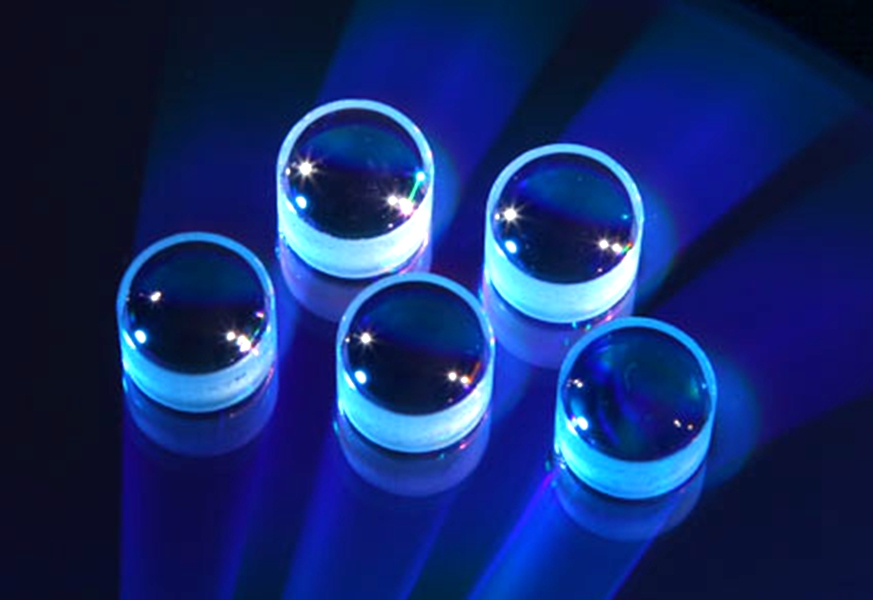
What makes a shaped piece of glass a useful optical lens? Its surfaces and material are chosen so that transmitted rays leave in the directions required by an optical design. Depending on the prescription, a lens can form an image, focus a beam or help produce collimated light.
Light changes direction when it crosses a boundary between materials at an angle. The refractive indices on either side and the local surface angle determine that change. A curved lens presents different surface angles across its aperture, allowing the component to redirect a bundle of rays.
Curvature and thickness therefore need to be considered with material choice. Common lens forms include plano-convex, biconvex, plano-concave and meniscus shapes. Spherical surfaces follow a constant radius; aspheric surfaces depart from that shape to provide additional control of ray paths.
A lens can be manufactured accurately and still show the aberrations inherent in its design. Surface accuracy and optical design quality are related, but they answer different questions.
Refractive index varies with wavelength. This dispersion means that different colors can focus at different positions. Combining appropriately selected glasses and lens shapes can reduce that error in a multi-element system.
Transmission is also wavelength-dependent. An anti-reflection coating can reduce reflection at the surfaces over its design range, but it does not remove absorption within the glass. The material, coating and working wavelengths must be considered together. See glass lens applications for examples of how the required function changes the priorities.
Glass lenses may be ground and polished, or precision molded where the material and geometry permit. Inspection should establish both the component geometry and its optical effect.
Dimensional checks establish size and thickness. Centration measurements assess alignment of optical surfaces to the intended axis or mechanical reference. Surface-form or transmitted-wavefront testing can identify optical errors that visual inspection cannot quantify. Scratches and pits require their own specified surface inspection.
Finally, evaluate the intended function, such as image contrast or beam focus, under defined conditions. The glass lens design guide explains how mounting and service conditions can change that result.
