

- Optical Tooling
- Tooling Videos
- Prism & Filters
- Custom Optical Parts
- Lighting & Illumination
- Medical & Endoscopy
- Optical Applications
- Automotive Optics
- Imaging & Vision
- Optical Capabilities
- Products & Applications
- Resource
- Custom Glass Optics
- Optical Molds
- OPtical Coating
- Optical Molding
- Consumer Electronics
- Industrial Vision
- Aspheric Lenses
- Spherical Lenses
Round Molded Optics: Inspection After Separation
Plan how individual optical parts are identified, handled and tested after runner removal. Use staged inspection to distinguish molding quality from downstream damage.
Inquiry- Description
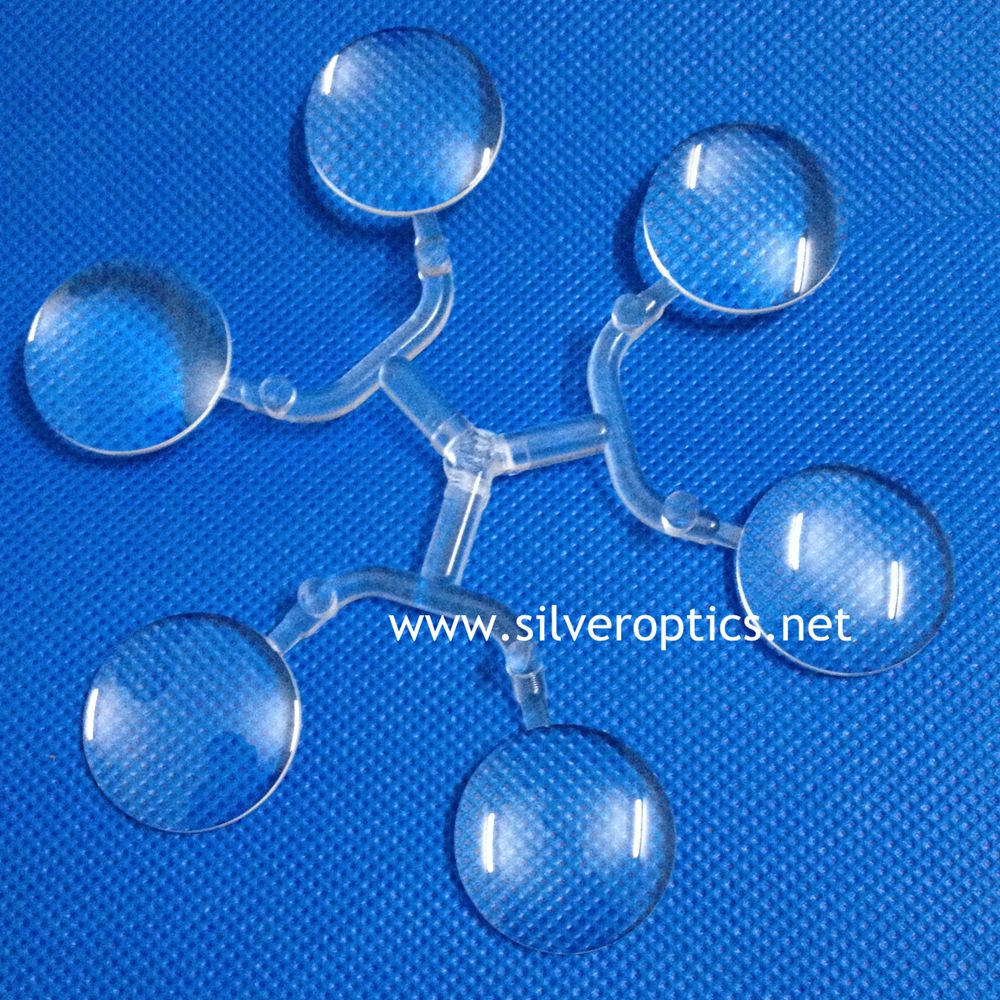
Image: Six clear round optical parts connected by a branching runner, shown before individual handling and inspection.
The photograph shows six clear round optical parts on a branching runner. Once separated, the parts need a defined route through handling, inspection and packaging. Planning that route early makes it easier to preserve optical surfaces and investigate a rejected part.
Keep identity when the runner is removed
Assign sample positions before separation and transfer that identity to a tray map or container record. Include the molding lot and any inspection status. Where parts can be reversed, define how their orientation will be recognized without adding marks to an optical surface.
Specify approved contact areas and a receiving tray for individual pieces. Check that the proposed arrangement prevents parts from touching one another or contacting a tray in the useful optical area. A photograph of parts on a runner does not establish how separated components should be supplied.
Use inspection stages to locate a problem
During trials, document appearance at agreed checkpoints: after removal, after any cleaning and before packaging. Use consistent lighting, orientation and inspection criteria. If a mark first appears after a particular step, investigate that step’s contacts and environment before assigning the defect to molding.
Select cleaning and handling methods using the confirmed resin grade and any coating specification. Avoid assuming that a cleaning liquid suitable for another optic is compatible. Where cleaning is needed, validate the proposed procedure on representative parts and retain the resulting inspection evidence.
Test the delivered condition
Agree the conditioning time and environment before measurement. Perform the required optical test on separated parts in a documented fixture, with the relevant wavelength and orientation defined. A visual surface check and a functional optical measurement answer different questions.
For an RFQ, include the individual-part drawing, optical acceptance test, permitted contact areas and packaging requirements. State whether downstream cleaning or coating is planned. A pilot pack-and-unpack evaluation can then check that the chosen presentation preserves the agreed condition. Our optical molding overview provides a starting point for discussing the complete supply process.
Consumer Electronics
SEND INQUIRY
Related Products
© Silveroptics 2026. All rights reserved
Powered by Silveroptics
Service
